



Kitchen roll in a professional kitchen: it’s not just a single consumable – it has four different uses
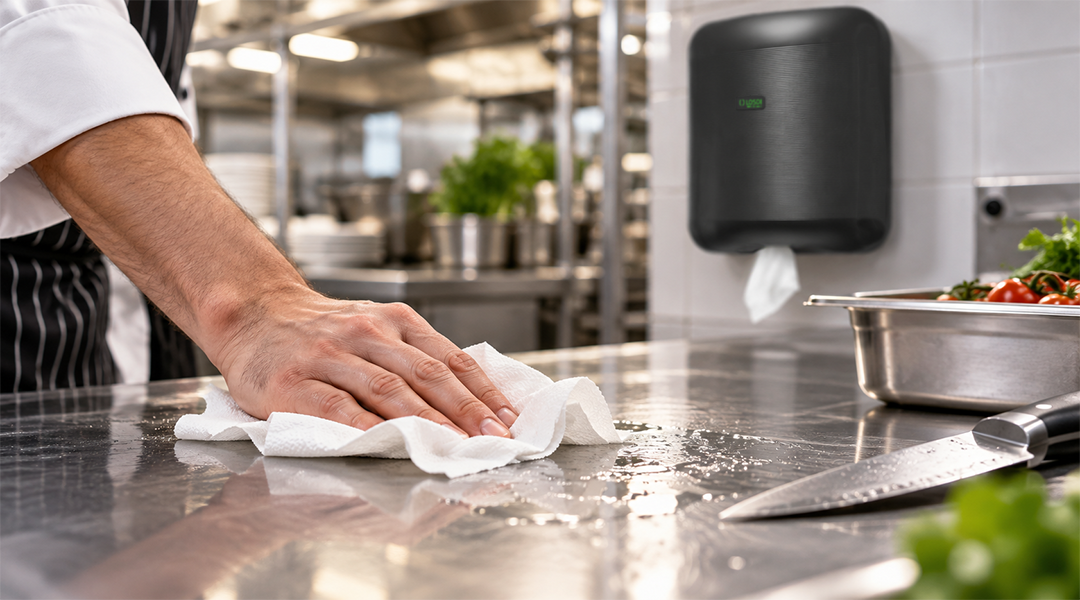
In a professional kitchen, kitchen roll serves more than one purpose. It can be used by someone drying their hands after washing them, by someone drying a chopping board they’ve just washed, or by someone draining fried food or wiping grease off the griddle when they’ve finished cooking.
There are four different tasks, all of which may require different amounts of paper and, depending on the purpose, paper with different properties as well.
And that is why it is important to keep an eye on when a particular brand ends up being used for several of these tasks, because very different needs start to get mixed up. The purchase is usually decided based on the price per box, and the rest of the details only become apparent later, when consumption skyrockets and nobody can explain why.
The mistake that makes paper more expensive without it being obvious
When there is only one point of use, the same format ends up meeting the needs of very different levels of consumption and requirements. The consumable chosen for hand drying may end up being used to remove water, dirt or grease as well, even though these tasks have different requirements.
And it’s for the simplest of reasons: it’s the nearest roll.
That is precisely where the mismatch lies. A task that requires a significant amount of paper is inefficient if it is carried out by repeatedly taking sheets from a format designed for small quantities. In the procurement report, this is interpreted as ‘a lot of paper is being used’. It is not always a problem of consumption. It is often a problem of allocation.
The important decision isn’t which roll of paper to buy, but how many rolls that kitchen needs and what each one is used for.
The four uses, and what format each one requires
The difference between one format and another does not lie in the paper: it lies in what determines the amount dispensed with each pull. In some cases, this is determined by the pre-cut length of the consumable; in others, by the user; and in others still, the dispenser itself incorporates a control mechanism.
That is why each use requires a different format.
Drying your hands after washing them.
High frequency and typically small, repetitive waste disposal, using single-use paper. It is disposed of in the sink in the kitchen area, which is not the staff toilet.
There are two types of product that fit into this category. The pre-folded towel dispenser, where the dispensing unit is defined by the pre-cut format of the consumable: the system is designed to dispense single sheets, which are always the same size. Certain LOSDI models can hold up to around 600 sheets and accommodate paper up to 110 × 240 mm, depending on the model. Alternatively, there is the controlled-dispensing version of the paper roll dispenser, where a dispensing control mechanism introduces greater resistance and restricts the freedom of extraction compared to a conventional roll. This gives the user some flexibility without reverting to pre-cut sheets.
Drying surfaces and tools.
Table, worktop, tray, knife – whenever the cleaning procedure requires moisture to be removed from a surface or utensil. The amount varies depending on what needs to be dried.
This is the natural environment for the wick-type paper dispenser: a roll from which paper is pulled from the centre, and where the user determines how much paper they need before tearing off the strip. When the amount varies with each use, a fixed-dose format forces the user to repeat the process. Depending on the model, LOSDI pull-through dispensers accommodate rolls up to approximately 205–210 mm in diameter and, depending on the model, up to 245 mm in height.
Direct contact with food.
Drain fried food; dry a product before labelling it. This is where the criteria change somewhat: in addition to the dispensing format, the suitability of the paper itself for its intended use with food comes into play.
What matters with regard to the equipment at this point is where it is positioned, not what type of paper it is. It is best for it to be a dedicated point, close to the production line, and not the same one used for cleaning. The choice of consumables is decided in consultation with the paper supplier, not the dispenser supplier.
Spills and grease.
Ironing board, hood, floor. The most important thing here is to have enough of it and to use the right type of paper for the cleaning job.
This is the type of use for which an industrial reel holder is designed. There is no pre-cut or control mechanism: the amount required for the task is drawn off and cut against the saw. For certain LOSDI models, the maximum diameter accommodated is up to around 420 mm and the height up to around 325 mm, well above what a wick dispenser can handle. It is available in both wall-mounted and floor-standing versions, allowing the paper feed point to be positioned close to where the work is being carried out.
Taken together, the four uses fall into two areas with distinct logics: the hand area, where the action is repeated and it is desirable for the amount taken to be predictable, and the work area, where the amount varies with each task and the equipment should not limit it.
When both needs are met from a single source, it is easy for the format chosen for one task to end up being used for the other as well. Keeping them separate prevents the same paper intended for drying hands from being used to clean the iron.
Before you decide anything, measure the wall
There’s the usual problem in any kitchen: the amount of space available.
As a guide, in terms of height × width × depth, a LOSDI wick dispenser measures approximately 35 × 27 × 24 cm, whilst an industrial wall-mounted roll holder measures approximately 40 × 42 × 38 cm. In a kitchen where the walls are already occupied by shelving, extractor hoods and electrical panels, the ability to adapt to the available space ultimately proves more important than anything else.
There are two specific solutions for this. When wall space is particularly limited, a mini-model reduces the dimensions of the dispenser unit to approximately 34 × 18 × 17 cm. And when wall mounting is not required, a floor-standing roll holder allows the paper dispenser to be moved and positioned wherever it is most convenient.
It’s worth measuring the wall before you order the catalogue, not afterwards.
Two separate conversations – and it is best not to mix them up
We need to be honest here about where our remit ends.
Absorbency, wet strength, resistance to grease and suitability for food contact depend on the paper: its weight, its layers and its composition. They do not depend on the dispenser. An excellent dispenser fitted with paper that falls apart when wet will still perform poorly.
The paper supplier must be asked to provide details of the paper’s grammage, number of layers, wet performance and suitability for the intended use. Where the paper is to be used in direct contact with food, you must check with the supplier that it is suitable for this purpose and request the relevant documentation. This must be done in writing, not verbally.
The dispenser manufacturer is asked what consumable sizes it supports — maximum diameter, maximum height, sheet dimensions or compatible format, depending on the system — and whether these specifications mean that a specific brand must be purchased.
That second question is the one that almost nobody asks, and it is the one that has the greatest impact on what follows.
Where does the real cost lie?
The price per box is the figure that anyone can work out most quickly, and it is the least decisive factor. For this reason, as well as the purchase price, it is worth bearing in mind at least four variables:
It depends on the action. If a single extraction is insufficient for the task, the user will have to repeat it.
What role does each job play? Using paper that is unsuitable for a particular task can increase both the number of printouts and the total amount of paper required to complete it.
How many points are there, and where are they? A poorly placed point leads you to use the one nearby, rather than the one intended for that task.
How often does it need to be replaced? The time spent by the team is also a cost, and it isn’t billed in the same way as paper.
Changing suppliers may improve the price or quality of the paper, but it does not, on its own, rectify an inappropriate allocation of formats, weights or uses. That decision must be made beforehand.
The dispenser you choose today will determine how you buy toilet paper tomorrow
The choice of dispenser determines the formats and sizes of consumables you will be able to use throughout the equipment’s service life. If, furthermore, it only accepts replacement parts from a single brand, today’s decision will dictate tomorrow’s supplier – and, with it, the price.
For LOSDI open-system models, compatibility is defined by the dimensions and consumable specifications indicated for each model. Within these limits, the customer can use a range of compatible consumables without being tied to a single brand. This means that repeat business must be earned on a case-by-case basis.
It’s not generosity. It’s a way of ensuring that your supply arrangements remain flexible should your needs, your purchasing conditions or your supplier change.
If you’re reviewing your kitchen’s paper supplies, drop us a line and we’ll go through them with you: how many rolls you need, which size fits each one, and what dimensions each product supports.
We’ll help you decide on the key points and formats.
Within the limits of each product’s specifications, you choose the paper.